2 Unit 01: Logic and Proofs
Geometry begins with a strange ambition: to say things that are not merely close to true, but exactly true. If you draw a triangle and measure its three angles, you may get 179.5^\circ or 180.3^\circ or, on a very careful day, something nearly indistinguishable from 180^\circ. But the drawing is made of graphite or pixels, the ruler has thickness, the protractor has markings, and your hand is not a machine. Measurement can persuade us that a claim is plausible. It cannot explain why the claim must hold for every possible triangle. For that we need proof: a way of starting from a small number of accepted rules and moving, step by justified step, to a conclusion that no shaky diagram can overthrow.
2.1 §1.1 Why geometry starts with rules
Suppose you draw ten triangles and measure their angles. A skinny triangle, a nearly equilateral triangle, a triangle with one very wide angle: again and again the sum comes out close to 180^\circ. This is good evidence. It is not yet mathematics in the strongest sense. You have checked some triangles, not all triangles. You have checked physical marks on paper, not ideal geometric objects. And even the triangles you checked were measured imperfectly.
Geometry therefore separates two kinds of truth. An empirical truth is supported by observation: the angles seem to add up, the lines appear parallel, the circles look as though they meet. A deductive truth is forced by reasoning: once certain starting rules are accepted, the conclusion follows whether or not a drawing is accurate. Kiselev makes this distinction sharply when he notes that geometry grew from practical observation but became mathematics only when Greek geometers began insisting on logical justification. Diagrams are still useful; they help us see what may be true. But a diagram is a witness, not a judge.
The central question of this course is therefore not “What does the picture look like?” but “What follows from the rules?” This is why geometry starts slowly. We must first decide what our basic objects are, what we are allowed to assume about them, and what counts as a legitimate step in an argument. Once that foundation is in place, the rest of Euclidean geometry becomes a tower: each theorem rests on earlier theorems, definitions, and postulates. The Greeks worked out this deductive style about 2,400 years ago, and it remains one of the most beautiful habits of mind in mathematics.
Euclid of Alexandria wrote the Elements around 300 BCE. It became the standard geometry text for over two thousand years and is the foundation of everything you will study in this course. We still teach geometry essentially the way he organized it: begin with a few primitive ideas, accept a few postulates, and then prove everything else.
2.2 §1.2 The pieces of a geometric system
A geometric system has several kinds of statements. Confusing them is one of the fastest ways to make proof feel mysterious. Once you know which kind of statement you are using, the logic becomes much cleaner.
Undefined terms are the primitive words of a theory. In Euclidean geometry, words such as point, line, and plane are treated as basic objects rather than defined in terms of simpler geometric objects.
This may feel unsatisfactory at first. Shouldn’t every important word have a definition? The difficulty is that definitions cannot go backward forever. If you define a point using another word, that other word needs a definition; then the words in that definition need definitions; and so on. At some stage a theory must say: these are the objects we begin with. Kiselev’s exercises make this explicit by asking which geometric notions are undefinable. The answer is not a weakness of geometry; it is what allows the system to begin.
Undefined terms do not mean “vague in practice.” We learn how points and lines behave through the postulates and through the theorems proved from them. In the same way, chess does not define a knight by describing horse-shaped wood. It defines a knight by saying how that piece may move. Geometry tells us what points and lines are by telling us what may be done with them.
There is a useful humility here. The word point in ordinary language may suggest a dot of ink, but a dot of ink has width. A geometric point has no width at all. The word line may suggest a pencil mark, but a pencil mark is thick and ends somewhere. A geometric line is perfectly straight and extends without bound. The undefined terms are therefore not everyday objects dragged into mathematics unchanged. They are idealizations, controlled by rules.
A defined term is a term whose meaning is fixed using earlier terms. For example, a segment is the part of a line between two points, and an angle is formed by two rays with a common endpoint.
Definitions are not discoveries; they are agreements. When we say an equilateral triangle is a triangle with three equal sides, we are not proving a theorem. We are fixing the meaning of the phrase equilateral triangle. Later, if we prove that an equilateral triangle also has three equal angles, that would be a theorem, because it is not built into the definition we chose.
Good definitions are powerful because they let us replace a word by its exact meaning. If M is the midpoint of AB, then by definition M lies on segment AB and AM=MB. Conversely, if M lies on AB and AM=MB, then M is the midpoint. A great deal of proof is simply the disciplined unfolding and refolding of definitions.
A definition also tells you when you are finished. To prove that a triangle is equilateral, you do not need to prove every attractive fact about it. You need to prove exactly what the definition asks for: three equal sides. To prove that a point is a midpoint, you need two facts: it lies on the segment, and it cuts the segment into equal parts. This habit prevents proofs from becoming clouds of true but irrelevant statements.
A postulate is a statement accepted without proof as a starting rule of the system.
Postulates are not random guesses. They are chosen to capture basic geometric behavior: two points determine a line, circles may be drawn with a chosen center and radius, right angles agree with one another, and so on. But within the system we do not prove them. We use them to prove other statements. If a proof secretly assumes something that is not a definition, postulate, or earlier theorem, then the proof has smuggled in an extra rule.
A good postulate is simple enough to be a starting point but strong enough to do work. Postulate 3, for example, looks innocent: draw a circle with a center and a radius. Yet in Proposition 1 it becomes the engine that creates two new equal lengths. Postulate 1 looks even simpler: draw the line through two points. Yet without it, we could not turn the circle intersection into the sides of a triangle. In geometry, the starting rules are small, but they are not weak.
A theorem is a statement proved from undefined terms, definitions, postulates, and previously proven theorems.
Theorems are earned. “Vertical angles are equal” is a theorem because it follows from the way straight angles and supplementary angles behave. “On a given segment, an equilateral triangle can be constructed” is a theorem because Euclid proves it using the line and circle postulates. The pleasure of geometry is that claims which first look like facts about a picture become consequences of a small logical machine.
A theorem may later behave like a tool. Once vertical angles have been proved equal, you do not need to reprove that fact every time two lines cross. You may cite it. This is how geometry accelerates: today’s conclusion becomes tomorrow’s justification. The price of that speed is honesty. You may cite only what has already been defined, assumed, or proved.
2.3 §1.3 Euclid’s Five Postulates
About 2,400 years ago, Euclid distilled the geometry of the plane into five postulates. Everything else in Book I of the Elements was meant to be proved from these five, together with definitions and common logical principles. Modern foundations are more careful than Euclid’s original list, and Kiselev points out that some assumptions were left implicit. Still, Euclid’s five postulates remain the right doorway into classical geometry.
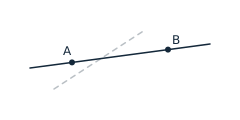
Postulate 1. Through any two distinct points, exactly one straight line can be drawn.
This is the most basic fact about lines. If you know two distinct points, the line through them is determined. Not approximately determined, not determined up to a small wiggle: unique. This is why two points are enough to name a line. If A and B are distinct, then “line AB” is unambiguous.
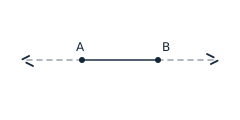
Postulate 2. A finite straight segment can be extended continuously in a straight line.
A segment is finite; a line is not. This postulate says that if you have a straight segment AB, you may continue it past A or past B without bending. The extension is not a new direction invented at the endpoint. It is the same straight path carried onward.
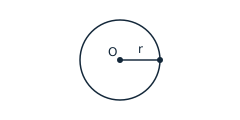
Postulate 3. Given any center and any radius, a circle can be drawn.
This is the compass postulate. If O is a point and r is a chosen distance, there is a circle consisting of all points at distance r from O. Notice how much is packed into this statement: we are allowed to transfer a distance as a radius, and every point on the resulting circle is exactly that distance from the center. Euclid’s first construction will use precisely this idea.
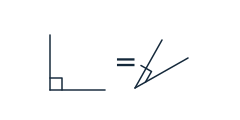
Postulate 4. All right angles are equal to one another.
A right angle is the angle formed when two lines meet perpendicularly. This postulate says there is only one size of right angle. It may face left, right, up, or down; it may appear in a tiny diagram or a huge construction; but as an angle it is the same. This lets us use 90^\circ as a stable standard.
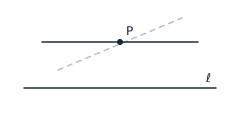
Postulate 5. Through a point not on a given line, exactly one line can be drawn parallel to the given line.
This is the parallel postulate, stated in the modern form you will use most often. Euclid’s original wording was more complicated: it described what happens when a line crossing two other lines makes the same-side interior angles sum to less than two right angles. Kiselev’s treatment around §§75–76 uses parallel lines as a central turning point, and later he explains why this postulate caused so much trouble. For about two thousand years mathematicians tried to prove the parallel postulate from the first four. They failed because it is not a consequence of them. In the 19th century, by replacing it with a different assumption, mathematicians discovered non-Euclidean geometry. That is an astonishing lesson: change one starting rule, and an entirely different geometry becomes possible.
2.4 §1.4 What a proof is
A proof is a sequence of statements in which each statement is justified by a postulate, a definition, a previously proven theorem, or a logical consequence of earlier statements. The sequence ends with the claim we wanted to prove. The small square \square at the end of a proof marks completion; it is the modern version of Q.E.D., from quod erat demonstrandum, meaning “which was to be demonstrated.”
There are two important habits here. First, a proof is not a story about how you discovered the result. Discovery can be messy. A proof is the cleaned-up chain of necessity. Second, a proof is not just a list of true statements. The statements must be connected so that each one follows from what came before.
The word “because” is the heartbeat of a proof. Every important line should be able to answer the question: because of what? Because of a definition? Because of a postulate? Because of a theorem already proved? Because of algebra applied to earlier equations? When a proof feels stuck, often the problem is not that the next step is clever; it is that the current step has not been justified precisely enough.
Paragraph proof. This is how mathematicians usually communicate. The reasoning is written in sentences, but the structure is still exact. For example: when two lines intersect, adjacent angles form linear pairs, so each pair sums to 180^\circ. If \angle 1 and \angle 2 form a linear pair, then \angle 1+\angle 2=180^\circ. If \angle 2 and \angle 3 form another linear pair, then \angle 2+\angle 3=180^\circ. Since both sums equal 180^\circ, they equal each other; subtracting \angle 2 from both sides gives \angle 1=\angle 3. Thus vertical angles are equal. \square
Two-column proof. This format is useful while training yourself because it forces you to separate what you claim from why you are allowed to claim it.
| Statement | Justification |
|---|---|
| \angle 1 and \angle 2 form a linear pair. | Definition of linear pair |
| \angle 2 and \angle 3 form a linear pair. | Definition of linear pair |
| \angle 1+\angle 2=180^\circ | Linear pairs are supplementary |
| \angle 2+\angle 3=180^\circ | Linear pairs are supplementary |
| \angle 1+\angle 2=\angle 2+\angle 3 | Both quantities equal 180^\circ |
| \angle 1=\angle 3 | Subtract \angle 2 from both sides |
Watch the proof unfold visually. Notice how no single step is dramatic; the force comes from the fact that each step depends on the one before it.
2.5 §1.5 Your first construction: Euclid’s Proposition 1
The first proposition in the entire Elements is not a flashy theorem about a complicated figure. It is a construction: build an equilateral triangle on a given segment. That choice matters. Euclid begins by showing that his rules can make something.
Proposition 1. On a given finite straight line segment, an equilateral triangle can be constructed.
Euclid’s tools are limited to what the postulates allow. Postulate 1 lets us draw straight lines through points. Postulate 3 lets us draw circles with chosen centers and radii. There is no marked ruler for measuring, no protractor for angles, and no hidden coordinate grid. The construction has to get equality of lengths from the geometry itself.
Proof. Let AB be the given finite segment. By Postulate 3, draw the circle centered at A with radius AB. By Postulate 3 again, draw the circle centered at B with radius BA. Let C be one of the intersection points of these two circles.
Since C lies on the circle centered at A with radius AB, the segment AC equals AB by the definition of a circle. Since C lies on the circle centered at B with radius BA, the segment BC equals BA. But BA is the same segment length as AB, so AC=AB and BC=AB. Therefore AC=BC=AB.
By Postulate 1, draw the straight segments AC and BC. The triangle ABC has three equal sides, so by definition it is equilateral. Thus on the given segment AB an equilateral triangle has been constructed. \square
What makes this beautiful is not that the picture is complicated. It is that every step is licensed. The two circles are not decoration; they are machines for producing equal distances. The intersection point C is chosen so that AC and BC inherit their lengths from the radii of the circles. And the argument works for any starting segment AB, not just the one drawn on the screen. This is the power of proof: a particular diagram reveals a universal reason.
The two-circle shape at the heart of this construction is called the vesica piscis — “bladder of the fish” in Latin. It appears across ancient art and architecture, from Roman mosaics to Gothic cathedral windows. It is also the symbol that appears in the sidebar of this course, since Proposition 1 is where Euclidean geometry begins.
2.6 §1.6 Direct and indirect proof
Most proofs in early geometry are direct proofs. You start with what is given, apply definitions and postulates, use earlier theorems when available, and eventually arrive at the desired conclusion. Euclid’s Proposition 1 is direct: draw two circles, connect the intersection point, and prove the three sides equal. The vertical angles proof is also direct: use two linear pairs, write two equations, subtract the shared angle.
A different style is indirect proof, also called proof by contradiction. Instead of proving the claim immediately, you temporarily assume the opposite of what you want. If that assumption leads to an impossibility, then the assumption must have been false, so the original claim must be true.
Indirect proof is especially useful when the claim says that something cannot happen. To prove that no object of a certain kind exists, it is often efficient to imagine that one does exist and then follow the consequences until the imagined object breaks the rules. The temporary assumption is not a belief; it is a test. If it produces a contradiction, the test has revealed that the assumption was impossible.
Claim. No triangle has two right angles.
Proof. Suppose, for contradiction, that some triangle has two right angles. Each right angle measures 90^\circ, so two right angles together measure 180^\circ. But the three interior angles of a triangle sum to 180^\circ, so the third angle would have to be 0^\circ. An angle of 0^\circ is not an angle of a triangle; it would mean two sides coincide rather than enclosing a region.
This contradicts our assumption that we had a triangle. Therefore no triangle has two right angles. \square
We have not yet proven that the angles of a triangle sum to 180^\circ. That proof comes in Unit 3. For now, accept it as a result we will earn later.
Proof by contradiction is powerful, but it must be used carefully. The contradiction should come from the assumption you made, not from a hidden change in the problem. When written well, an indirect proof has the feeling of a trap closing: the false assumption has nowhere to go.
2.7 §1.7 Exercises
Now you try. These are graded by difficulty. ★ are warm-ups. ★★ require you to think. ★★★ will take real effort. When you get stuck, that is the point at which actual learning happens. Sit with the hard ones. Use the chat assistant when you need a nudge — but not for the answer.
Exercise 1.1. ★ Classify each statement as a definition, a postulate, or a theorem.
- Through any two points there is exactly one line.
- An equilateral triangle has three equal sides.
- The sum of the angles of a triangle is 180^\circ.
- A right angle is an angle whose measure is 90^\circ.
Exercise 1.2. ★ List the five Euclidean postulates from memory. Try first, then check against §1.3.
Exercise 1.3. ★★ A two-column proof has been partially filled in. Complete the missing statements and justifications.
Claim. If two angles are each supplementary to the same angle, they are equal to each other.
| Statement | Justification |
|---|---|
| \angle 1 and \angle 3 are supplementary | Given |
| \angle 2 and \angle 3 are supplementary | Given |
| \angle 1 + \angle 3 = 180^\circ | [fill in] |
| [fill in] | Definition of supplementary angles |
| \angle 1 + \angle 3 = \angle 2 + \angle 3 | [fill in] |
| [fill in] | Subtract \angle 3 from both sides |
Exercise 1.4. ★★ Write a paragraph proof for: If point M lies on segment AB and AM = MB, then M is the midpoint of AB. Use the definition of midpoint and the given information. Keep it short — three to four sentences should suffice.
Exercise 1.5. ★★★ Prove that vertical angles are equal. State your postulates, definitions, and reasoning step by step. Either paragraph or two-column form is fine. The proof should be short, but every step must be justified.
Exercise 1.6. ★★★ A proof by contradiction. Prove that the sum of two acute angles is always less than 180^\circ. An acute angle is one whose measure is less than 90^\circ. Assume the opposite and derive a contradiction.
2.8 §1.8 What’s next
Unit 2 applies these tools to the basic objects of plane geometry: lines, angles, and the relationships that appear when lines intersect or run parallel. The five postulates and the proof structure you just learned are the only tools you will need. Keep Kiselev nearby. Read alongside this unit. Sit with the proofs until every step has a reason.